
Ask any new driver what scares them most, and nine times out of ten the answer is reverse parking. Driving forward is fine. Changing lanes, okay. But the moment you have to look into those small mirrors and back the car into a tight space? Sweaty palms. Blank mind. Somebody honking behind you, probably.
We get it, and honestly, it’s normal. Reverse parking isn’t a talent you’re either born with or not. It’s a few small moves done slowly and in the right order, nothing more. Once those moves click (and with a bit of practice, they do), you’ll wonder why it ever felt so hard.
In this guide we’ll go through it step by step, pretty much the way our instructors explain it to learners in Islamabad and Rawalpindi. We’ll also cover the mistakes nearly everyone makes, what the license test expects from you, and how to survive parking outside a crowded market or plaza.
What Is Reverse Parking?
Simple version: reverse parking means backing your car into a space instead of driving in nose-first.
You’ve seen it a hundred times. Outside shops, in office car parks, down in plaza basements. The car goes in backwards, and later, when it’s time to leave, you just drive straight out. No awkward reversing into traffic.
There are two types you’ll run into:
● Reverse bay parking: backing into a marked bay, like in a mall or office parking lot
● Parallel parking: reversing into a gap between two cars parked along the road (the one that scares people even more)
We’re sticking mostly to reverse bay parking here. It’s the one you’ll use most, and the one learners usually tackle first.
Why Reverse Parking Is Worth Learning
Fair question: “Why bother? Why not just drive in forwards?” Well, there are a few good reasons:
● Leaving is easier and safer. You pull out facing forward, so you can actually see the bikes, pedestrians and cars coming. Much better than reversing out blind.
● Tight spaces become easier. A car turns more sharply in reverse, so getting into a narrow spot backwards is often easier than going in front first.
● It’s part of the license test. The S-shape and L-shape tests both need decent control in reverse.
● It builds real confidence. Once you can do this, most other parking feels like nothing.
Before You Start: Get the Basics Right
Before you put the car in reverse, sort out these few things. They take a minute and save a lot of stress.
Set Your Seat and Mirrors
Start with the seat. You should be able to press the pedals all the way down and turn the wheel without stretching your arms. Then the side mirrors: you want to see just a sliver of your own car, with the rest showing the road. The rear-view mirror should show the whole back window, not the roof and not your own face.
Badly set mirrors make reverse parking so much harder. Seriously, don’t skip this.
Know Where Reverse Gear Is
In manual cars, reverse can sit in different places depending on the model. Some want you to push the gear lever down before it goes in, others have a little ring under the knob that you lift. Whether you’re learning in a Mehran or a Corolla, ask your instructor to show you. In an automatic it’s easy. Just move the lever to R.
Go Slow. Really Slow.
This is the golden rule. If you remember nothing else from this guide, remember this. You should be moving at walking speed, or slower. In a manual, the clutch does the work: ease it out gently and keep your right foot off the accelerator most of the time. In an automatic, let the car creep by itself and keep your foot over the brake.
Can’t decide between manual and automatic yet? Our guide on manual or automatic driving breaks it down.
How to Do Reverse Parking Step by Step
Right, here’s the actual method. We’ll use a space on your left as the example. If your space is on the right, the steps don’t change. You just do everything the other way round.
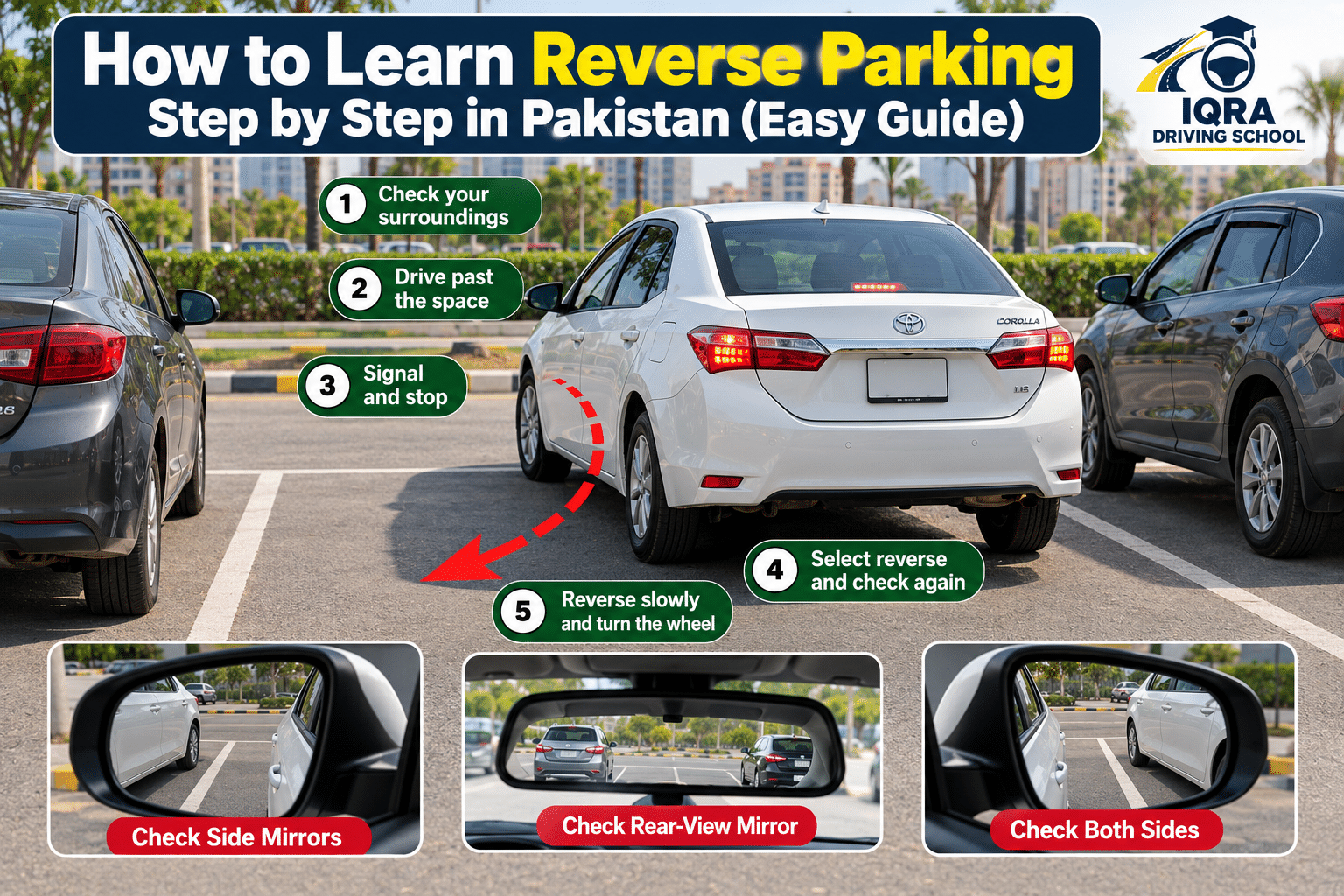
Step 1: Pick Your Space and Check Around You
Pick your space, then look around properly. Is someone walking between the cars? A motorbike coming up from behind? Kids running around? Don’t rush this bit. It only takes a few seconds.
Step 2: Drive Past the Space
Drive forward slowly. Leave a gap of about a door’s width between you and the parked cars or lines, so roughly a metre, maybe a little more.
Go past your space. A good place to stop is when your shoulder lines up with the line one or two bays ahead of the one you want. This point changes slightly from car to car, so your instructor will help you find the right one for yours.
Step 3: Signal and Stop
Indicator on, so everyone knows what you’re doing. Then come to a full stop.
Step 4: Select Reverse and Check Again
Put it in reverse. Now check again, all of it: both side mirrors, the rear-view mirror, and a proper look over your shoulder. Clear? Then you can move.
Step 5: Reverse Slowly and Turn the Wheel
Start reversing, really slowly. As soon as the car is rolling, turn the steering wheel all the way to the left, towards the space.
Watch your left mirror. You’ll see the corner of the bay and the line coming closer. Keep it slow. There’s no hurry.
Step 6: Watch Both Mirrors
As the car swings into the space, check both side mirrors. The idea is to end up with the same gap on each side, sitting nicely between the lines.
Getting too close on one side? Stop. Straighten the wheel a bit, then move back slowly again. Even experienced drivers make little corrections like this all the time.
Step 7: Straighten the Wheel
When the car is parallel with the lines on both sides, straighten the wheel. Quick tip: from full lock, it usually takes about one to one and a half turns to get the wheels straight again. You’ll get a feel for it after a few tries, and your instructor will help.
Step 8: Reverse Straight Back and Stop
Now keep reversing in a straight line until the whole car is in the space. Look over your shoulder and in the mirrors so you don’t go too far back. Wall or car behind you? Leave a safe gap.
Step 9: Secure the Car
Handbrake up. In a manual, leave it in neutral or first gear. In an automatic, move the lever to P. Engine off. Done.
That’s really all there is to it. Nine steps. Read through them a couple of times and they’ll start to stick.
Reverse Parking Reference Points (The Easy Trick)
Here’s where most learners get stuck. Not the steering. The timing. They just don’t know when to turn. Reference points sort that out.
A reference point is a spot on your car or mirror that lines up with something outside, like a parking line. When they line up, that’s your cue for the next step. A few examples:
● Parking line level with your shoulder? Stop and get ready to reverse.
● Corner of the bay showing in a particular spot in your side mirror? Start turning.
● Lines in both mirrors look parallel to the car? Straighten up.
Every car is slightly different, so these points won’t be exactly the same for everyone. A good instructor will show you the ones for the car you’re learning in. Once you know them, you stop guessing.
Common Reverse Parking Mistakes (and How to Fix Them)
Almost everyone makes these at some point. Don’t feel bad about it, just learn from them.
● Going too fast. The number one mistake, by far. If we had a rupee for every learner who rushed this part… Slow down. Going slow keeps you safe and gives you time to fix things.
● Turning the wheel too early or too late. Too early and you’ll hit the side line. Too late and the car ends up crooked. Use your reference points.
● Only looking in one mirror. Check both sides. And over your shoulder.
● Not stopping to correct. Something looks wrong? Just stop. Straighten a little, then go again. Nobody’s giving out prizes for getting it in one go.
● Forgetting to straighten the wheel. Leave it too late and the car keeps turning, and you end up parked at an angle.
● Trusting the parking sensor or camera blindly. They’re helpful, sure. But they don’t replace your own eyes and mirrors.
Curious what other mistakes new drivers make? We’ve covered the most common driving mistakes in a separate guide.
Reverse Parking in Busy Places in Pakistan
Practising in an empty lot is one thing. Doing it outside a busy market? Completely different story.
Think Saddar, Commercial Market or a packed plaza in Blue Area. People walking behind your car, bikes squeezing past, the parking attendant shouting “peechay, peechay!” and someone honking because they want your spot. Here’s how to keep calm:
● Take your time. The guy honking can wait a few seconds. Your safety matters more than his hurry.
● Watch for pedestrians and bikes. They can appear behind you out of nowhere, so keep checking your mirrors.
● Use your indicator early. Let people know what you’re about to do.
● If it doesn’t feel right, drive out and try again. Nothing wrong with a second attempt. Or a third.
● In basements, use your headlights and go even slower. Pillars and corners are hard to see down there.
Reverse Parking and the Driving License Test
In Pakistan, the license test usually has you drive through S-shape and L-shape tracks, and that includes reversing. You need to stay inside the lines and not hit any of the poles or markers.
This is exactly where reverse parking practice helps: going slow, using your mirrors properly and turning the wheel at the right time.
Iqra Driving School’s license preparation training covers S-shape and L-shape maneuvers, forward and reverse practice, plus parking and reversing control. In other words, you practise the same things the test checks.
How Long Does It Take to Learn Reverse Parking?
Honestly? It’s different for everyone. Some people get the hang of it in a few lessons. Others need more time. Both are fine.
What really helps is regular practice in a safe place, with someone next to you who knows what they’re doing. If you’re wondering how long the full learning process takes, we’ve written about how long it should take to learn to drive.
Tips to Get Better at Reverse Parking Faster
● Practise in an empty space first. Early mornings or a quiet lot on a Sunday work really well.
● Use cones or bottles as markers if there are no lines. Empty water bottles do the job just fine.
● Practise both sides. Almost everyone has a side they’re better at. Spend more time on the other one.
● Get out and look. After parking, step out and see how straight you actually are. You’ll learn faster this way than from any video.
● Stay relaxed. A calm driver makes better decisions. A stressed one usually doesn’t.
Brand new to driving? Our guide to your first driving lesson tells you what to expect on day one.
And if you’re curious how people park in other parts of the world, Wikipedia has a decent page on parking.
Learn Reverse Parking With a Trained Instructor
Reading about it is a good start. But nothing beats having someone in the passenger seat who says “stop,” “turn now” or “straighten up” at exactly the right moment.
At Iqra Driving School, we teach in both manual and automatic cars. Have a look at our driving packages page for the options, or see everything we offer on our driving services page. Still not sure which package suits you? Our guide on how to choose the right car package for your first lessons should make it easier.
Frequently Asked Questions About Reverse Parking
Is reverse parking hard to learn?
It feels hard at the start, but it isn’t really. Once you know the steps and your car’s reference points, it gets easier every time you practise.
Is reverse parking easier than forward parking?
In tight spaces, usually yes. A car turns more sharply in reverse, so getting into a narrow space backwards is often easier. And driving out afterwards is safer.
Should I use the parking camera or sensors?
Yes, but as a helper, not your only guide. Keep checking your mirrors and looking over your shoulder too.
Is reverse parking easier in an automatic car?
A little, maybe, because there’s no clutch to worry about. But the steering and mirror skills are exactly the same.
Is reverse parking part of the driving test in Pakistan?
The test usually includes S-shape and L-shape maneuvers with reversing. If you can reverse park well, those feel a lot easier.
How can I stop feeling nervous while reverse parking?
Go slowly. Don’t rush. Practise somewhere quiet first. Every attempt adds a little more confidence, and it builds up faster than you think.
Final Thoughts
Reverse parking looks hard when you watch someone else do it fast. Break it down, though, and it’s pretty straightforward: drive past the space, check around, reverse slowly, turn the wheel, watch both mirrors, straighten up, stop.
Go slow, stay calm, practise often. Before long you’ll be backing into spaces without even thinking about it.
Want an instructor beside you while you learn? Apply for driving lessons at Iqra Driving School in Islamabad and Rawalpindi today.